
|
|
| Products & Prices | Technical Details | Suppliers | Contacts | About Us | Home |
 |
. |

|
| Animation of the Parallel Path Method |
. | Animation of the Enhanced Parallel Path Method |
|
Enhanced Parallel Path Method US Patent # 6,634,572 Canadian Patent # 2,384,201 |
|
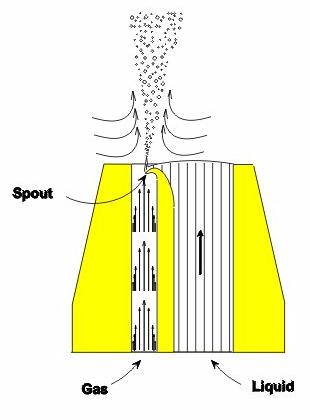
Burgener Nebulizers use the patented Enhanced Parallel Path Method. They work on the basic principal that any body of liquid can be used to produce a fine mist with a gas stream, if they are in close proximity to each other. It is not necessary to have a critical alignment of the gas stream and the liquid. This understanding allows us to produce a nebulizer with a very large opening for the liquid path, preventing the common problem of tiny particles in the liquid from plugging the sample path. Our nebulizers actually have the sample path increase in size near the gas stream, so that plugging is rare. The Enhanced Parallel Path Method is a significant advancement on our original Parallel Path Method of atomizing liquids. Instead of just having the liquid near the gas stream and being inducted into the gas flow, the Enhanced Method uses a spout protruding into the gas stream. The surface tension of the liquid draws the liquid into the spout and the gas stream impacts the liquid, causing it to break up into small droplets. The Enhanced Method does not use gravity or induction. As such, it has zero back pressure and zero suction, and operates equally well in any orientation. Babington V Groove designs use gravity to deliver the liquid to the gas stream. The Enhanced Parallel Path Method is not a Babington design. This enhancement enables the liquid to interact with the gas stream in the central portion of the gas stream. Gas streams in capillaries have velocity gradients across the diameter of the capillary, with the slowest gas moving at the edges of the capillary and the fastest at the center. The central gas flow is 3 to 10 times as fast as the gas at the edge of the stream. If the central portion of the gas stream can impact the liquid, then the gas impacts the liquid with much more energy. Energy is related to the square of the velocity, so 3 to 10 times the speed is 9 to 100 times the energy. With such an increase in energy transfer from the gas to the liquid, the liquid is broken up into much smaller droplets. This produces a mist with average droplet sizes much smaller than any other method for the same gas flow and pressures. |
 |
|
Our new enhanced method is now being used on all of our nebulizers. This has significantly improved sample throughput to the torch, enabled much lower flow rates than previously possible, and produces a more stable mist than previously possible. Our design also allows us to fabricate the nebulizer out of Teflon® (PTFE, FEP & PFA). Teflon is essentially inert to laboratory chemicals, acids and solvents, and is practically non-wetting. This enhances the nebulizer's ability to operate with high dissolved solids. The common problem of salts forming around the gas stream does not occur with Teflon. Teflon does not wet and the salts do not form. There can be some salting with very high Sodium (Na) salts. This is a reaction between Na ions with the Fluorine in the Teflon, and can produce an insoluble salt in some instances. This is RARE: less than 1% of our nebulizer customers have reported this occurrence. For those that do experience this salting, it occurs at rates that are very much slower than with glass or sapphire nebulizers. And the salts can usually be washed off with a dilute HF acid wash. |
|
|
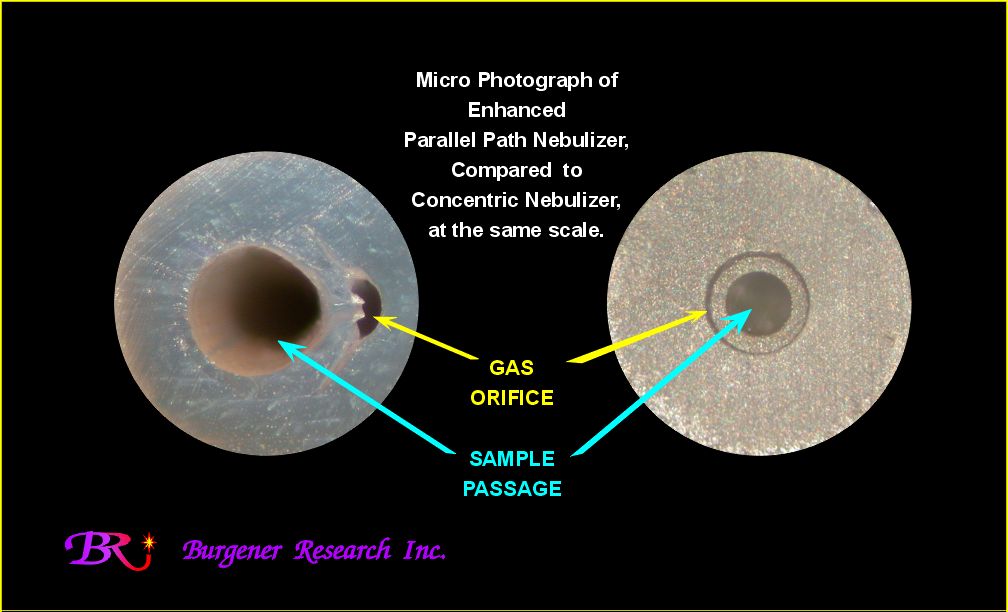
Note that the gas orifice on the Enhanced Parallel Path Nebulizer is very much larger than the gas orifice on the concentric. Any salts forming on the concentric will easily plug part of the orifice. Any salts forming in the parallel path orifice have to be very large to have any effect on the gas flow, and usually such salts simply blow away. Also note that the Enhanced Parallel Path design has a gas orifice is actually circular, and the path you see in the photograph is a spout that dips into the middle of the gas stream much like a tea-pot spout. The surface tension of the liquid fills the end of the liquid passage and also the spout, so that the liquid is touching the gas stream, and interacting directly with the center area of the gas stream. |
|
UpChurch Scientific, a dividsion of Idex, is a producer of chromatigraphic and gas line fittings. Teflon is a registered trademark of E.I. DuPont De Nemours Company and in all cases in this web page refers to PTFE (PolyTetraFluoroEthylene) or FEP (Fluorinated Ethylene-Propylene) |